Verónica Andreo
  • Publications
  • Courses
  • Talks
  • Posts
  • CV

Verónica Andreo

Researcher & Lecturer

CONICET · Instituto Gulich – CONAE/UNC · Córdoba, Argentina

My research asks a simple question with a difficult answer: where and when do environmental conditions converge to make a disease outbreak likely? I look for the answer in satellite data — and in the ecology of the species that carry the pathogens.

I am a biologist, and I work with Earth observation in all its forms — optical, thermal and radar imagery, dense satellite time series, and the environmental indicators built from them — combining it with spatio-temporal statistics and machine learning to model where species live, how their populations shift through the year, and how that turns into forecasts and risk maps, early enough for them to be useful.

That work runs on open source tools, and part of my time goes back into them. I am part of the GRASS development team and have chaired its Project Steering Committee since 2021, I teach GRASS and geospatial courses regularly, and I am an active member of OSGeo and the FOSS4G community.

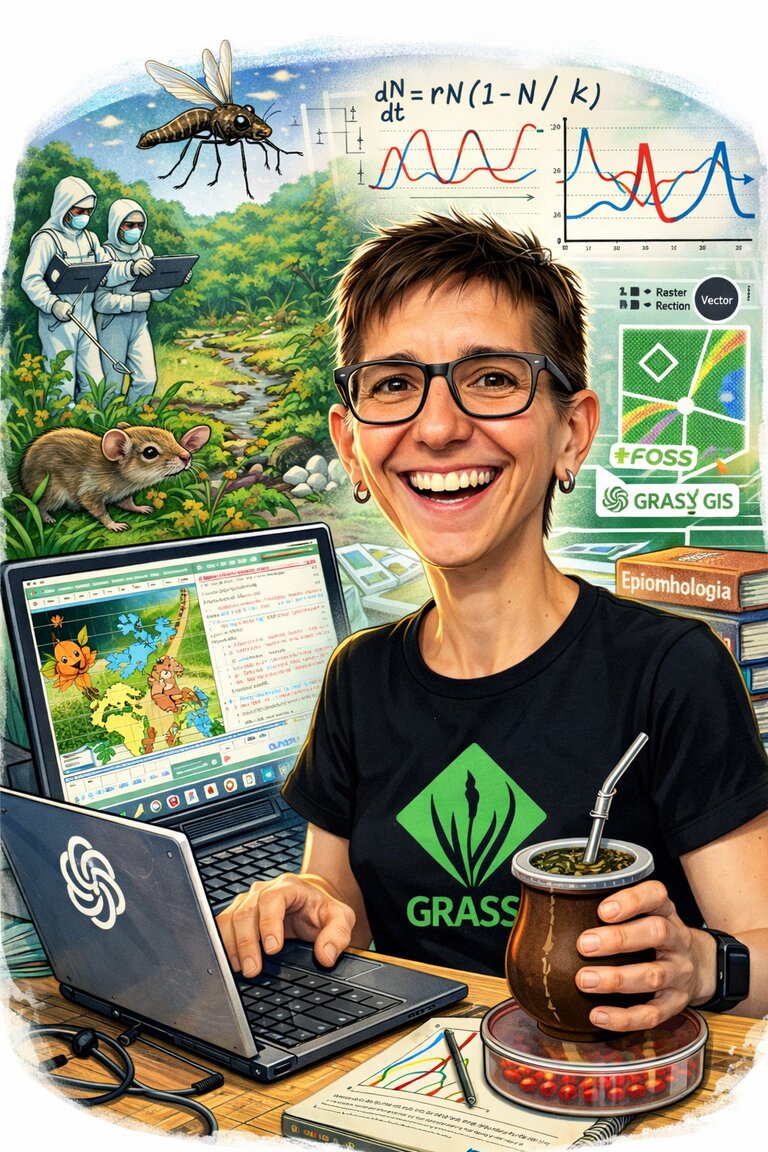
Ilustración de Verónica Andreo trabajando con GRASS

Interests

What I study

  • Ecology of vector-borne and zoonotic diseases
  • Species distributions and population dynamics
  • Environmental drivers of outbreak risk

Data I work with

  • Satellite image time series
  • Optical, thermal and radar Earth observation
  • Climate and environmental variables

How I work

  • Spatio-temporal modeling
  • Machine learning and species distribution models
  • Risk mapping and forecasting
  • Open source geospatial software

Skills

Remote sensing

Geospatial analysis

Modeling

Data science

Coding

Scientific writing

Recent publications

Environment-based strategy for monitoring early colonization of Lutzomyia longipalpis at the city scale
Surveillance
Remote sensing
Species distribution models
Vector-borne diseases
Risk mapping
M. G. Quintana, V. Andreo, R. Cavia, M. S. Santini, S. L. Moya, L. G. Estrada Méndez, O. D. Salomón
2026
Distribution and richness of Orthohantavirus reservoir hosts: Implications for zoonotic risk in southern South America
Species distribution models
Risk mapping
Genetics
Hantavirus
Biodiversity monitoring
J. D. Pinotti, V. Andreo
2026
Distribution of Mother-to-Child Transmitted (MTCT) Infections and Socioeconomic Vulnerability Within the Gran Chaco Region
Chagas
Time series
C. Rodríguez González, S. Ávila, K. Cardone, M. Fernández, F. Crudo, V. Andreo, M. V. Periago
2026
How much can mosquito population dynamics models inform entomological surveillance? Assessing the transferability of Aedes aegypti climate-driven models in Argentina
Invasive species
Surveillance
Modeling
Public health
Vector-borne diseases
T. V. San Miguel, D. Da Re, M. O. Espinosa, M. V. Periago, L. Lopez, C. Guzman, V. Andreo
2026
AedesTraits: a global dataset of temperature–dependent trait responses in Aedes mosquitoes
Mosquitoes
Arboviruses
Climate
D. Da Re, V. Andreo, T. V. San Miguel, M. Blaha, R. Rosa, A. Rizzoli, J. Harrison, S. Sorek, L. Johnson, P. Huxley
2025
A systematic review of remote sensing data in studying the association of air pollution and Asthma/Allergic Rhinitis
Air pollution
Remote sensing
A. Coiman, M. F. Garcia Ferreyra, V. Andreo
2025
No matching items

All publications →

Experience

CONICET

Associate Researcher

CONICET

November 2023 – Present · Córdoba, Argentina

NCSU

Research Scholar

GGA – North Carolina State University

March – August, 2024 · Raleigh, USA

CONICET

Assistant Researcher

CONICET

July 2018 – October 2023 · Córdoba, Argentina

University of Twente

Postdoc Researcher

ITC – University of Twente

July 2016 – June 2018 · Enschede, The Netherlands

FEM

GIS technician

CRI – Fondazione Edmund Mach

May – July 2015 · San Michele all’Adige, Italy

Contact

veronica.andreo@ig.edu.ar

Instituto Gulich, Ruta Provincial C45 Km 8, Falda del Cañete, Córdoba (5187), Argentina

Mon to Fri, 08:30 to 16:30

View on OpenStreetMap →

Back to top

© 2026 Verónica Andreo  ∙  Made with Quarto  ∙  CC BY-NC-ND 4.0